

Shifting your business model requires strategy. Relying on drive up traffic limits your total inbound tonnage. If you want to build a stable and highly profitable enterprise, you must master commercial scrap metal recycling.
Securing massive industrial accounts like demolition crews, manufacturing plants, and large contractors changes your operational reality. It guarantees consistent volume. It also requires flawless execution. Failing to service a commercial client results in lost contracts and severely damages your reputation. You must upgrade your infrastructure to handle commercial volume correctly.
The Shift From Retail Peddlers to Commercial Scrap Metal
Retail peddlers provide immediate cash flow but offer zero predictability. A yard dependent on street traffic suffers heavily during market downturns. Transitioning your focus to commercial scrap metal provides essential stability.
Manufacturers produce industrial offcuts and turnings every single day regardless of the global market price. Servicing these suppliers transforms your yard from a passive receiving facility into a proactive logistics partner. Upgrading your operations to handle this consistent volume is the first step toward building a resilient business.
Building Profitable Commercial Metal Recycling Services
Providing commercial metal recycling services demands precision. You are no longer just buying metal. You are providing a critical waste management utility for other businesses.
Securing High Volume Industrial Accounts
Winning these contracts requires your senior purchasing teams to present clear value. Commercial clients care about fast service, accurate weights, and transparent pricing. You must prove your capability to handle their specific material output seamlessly.
Executing Reliable Commercial Scrap Metal Collection
The physical movement of material is your biggest operational risk factor. Commercial scrap metal collection requires tracking hundreds of roll off bins and trailers across the city.
- You must minimize empty miles to protect fuel budgets.
- You must optimize turn times at the customer site.
- You must maximize asset utilization so trucks never sit idle.
- You must communicate pickup schedules clearly to the supplier.
Managing Logistics in Commercial Scrap Metal Recycling
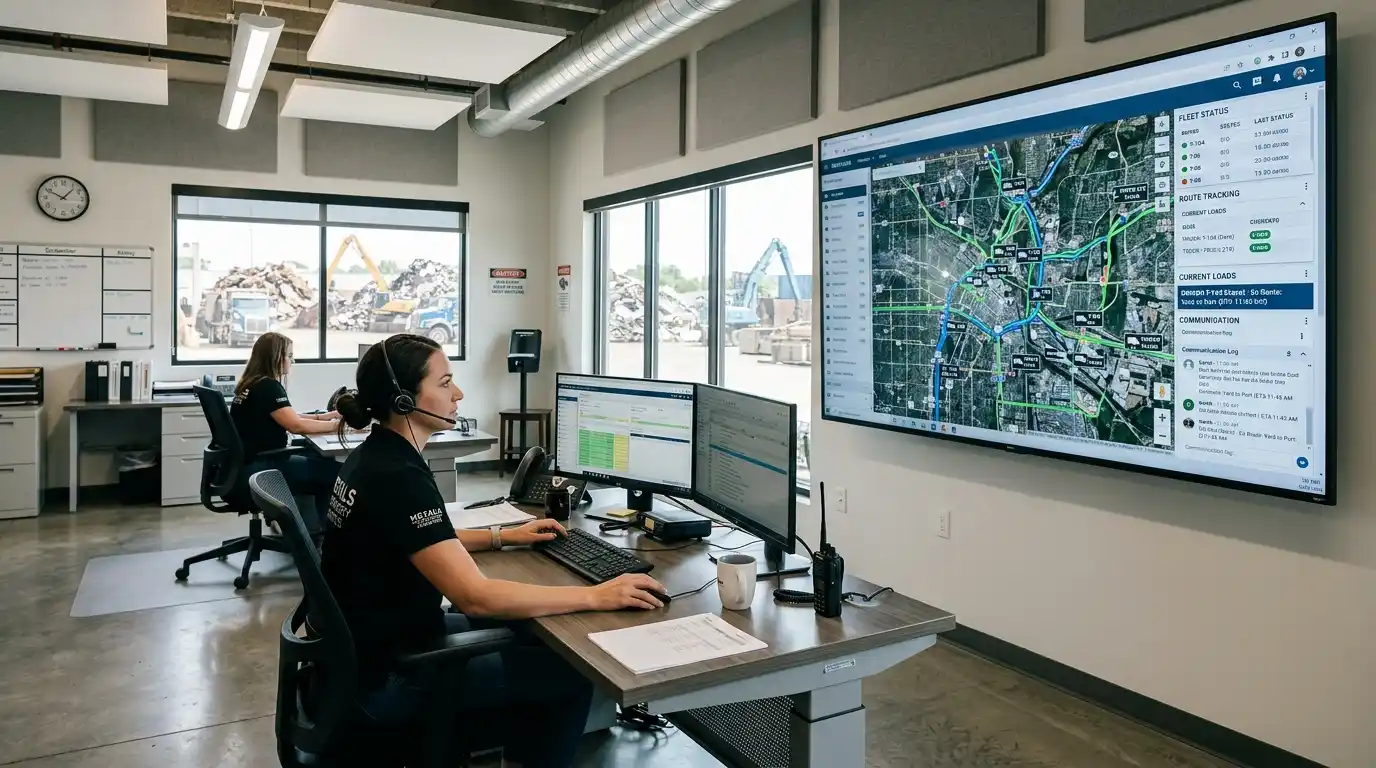
Scaling your commercial scrap metal recycling operation is impossible without strict fleet control. Whiteboards and text messages fail completely when managing high volume routes.
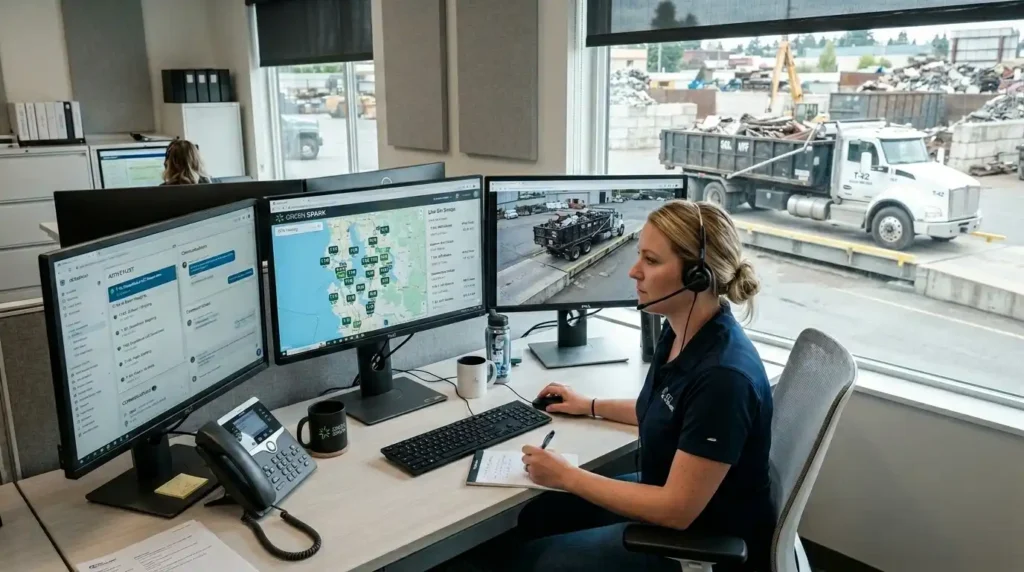
Dispatchers need live GPS tracking and digital routing. Connecting your fleet directly to your core operating system removes severe bottlenecks when processing inbound loads. When the scale house knows exactly what the truck is hauling before it arrives, the entire yard operates faster.
By optimizing fleet routing digitally, you reduce overhead and increase the number of daily bin swaps your drivers can complete.
Handling Complex Pricing for Commercial Metal Recycling
Industrial suppliers do not accept flat board prices. They demand sophisticated formula pricing tied to specific market indices like COMEX or LME.
Managing commercial metal recycling requires tying every contract to live market feeds. If the copper market drops, your buying price must adjust instantly. Relying on spreadsheets to track these changes causes massive margin erosion.
You need a system capable of managing complex supplier contracts automatically. Using intelligent tools for automating formula pricing updates guarantees your buyers quote the correct price every single time.
| Pricing Method | Risk Level | Operational Requirement |
| Flat Board Pricing | High risk during volatility | Manual daily updates |
| Tiered Volume Pricing | Moderate risk | Constant manual volume tracking |
| Index Formula Pricing | Low risk, protected margins | Automated software integration |
Scaling Your Commercial Scrap Metal Recycling Growth
The gap between average yards and top performing enterprises comes down to technology. Relying on outdated manual processes caps your total volume. Modernizing your commercial scrap metal recycling operation delivers verifiable financial returns by eliminating costly administrative errors.
When you upgrade your foundation, expanding across multiple regions becomes a predictable process. Your team stops chasing paperwork and starts focusing on physical throughput.
This transition also completely streamlines the work for your back office. Automatically reconciling monthly accounts gives ownership the confidence to acquire new yards and bid on larger contracts. To see exactly how these tools perform in a live environment, you can evaluate modern technology today.
Frequently Asked Questions (FAQs)
How do commercial metal recycling services differ from retail scale purchasing?
Retail purchasing involves walk up traffic with flat pricing and immediate cash payouts. Commercial services involve long term contracts, formula based pricing, scheduled logistics, and digital invoicing for large industrial businesses.
What is the most efficient way to track commercial scrap metal collection bins?
You must assign unique digital identifiers to every physical container. Modern software maps these assets to specific customer locations automatically. When a driver swaps the bin, the system updates the inventory location instantly.
How should a yard handle formula pricing for commercial scrap metal contracts?
Yards must tie contract pricing directly to live market feeds like COMEX. When the market index shifts, the software must update the supplier’s buying price automatically. This eliminates manual data entry and protects profit margins.
What software features are mandatory for managing high volume commercial accounts?
You need real time container tracking, automated dispatch routing, integrated formula pricing, and a digital customer portal. These features ensure the supplier receives accurate documentation and fast service.
How does a dedicated dispatch system improve commercial scrap metal recycling margins?
It reduces fuel burn by clustering geographic pickups. It minimizes driver idle time. It also prevents the dispatching of trucks for single low weight pickups, ensuring every trip generates maximum inbound revenue.