


AI Scrap Software Is Transforming the Recycling Industry
For decades, scrap software was viewed as infrastructure – necessary, functional, and often frustrating. It printed tickets, generated invoices, tracked contracts, and helped close the month. In most organizations, software was treated as a cost center rather than a strategic advantage.
That era is ending.
For the first time in the history of the scrap industry, scrap software is becoming a competitive advantage – not because it has more features, but because it is beginning to think, act, and execute alongside operators.
That shift is only possible with modern architecture.
Modern platforms like GreenSpark’s scrap recycling software platform connect dispatching, ticketing, pricing, inventory, exports, and accounting into a single unified system so recycling companies operate from one operational data model instead of disconnected tools.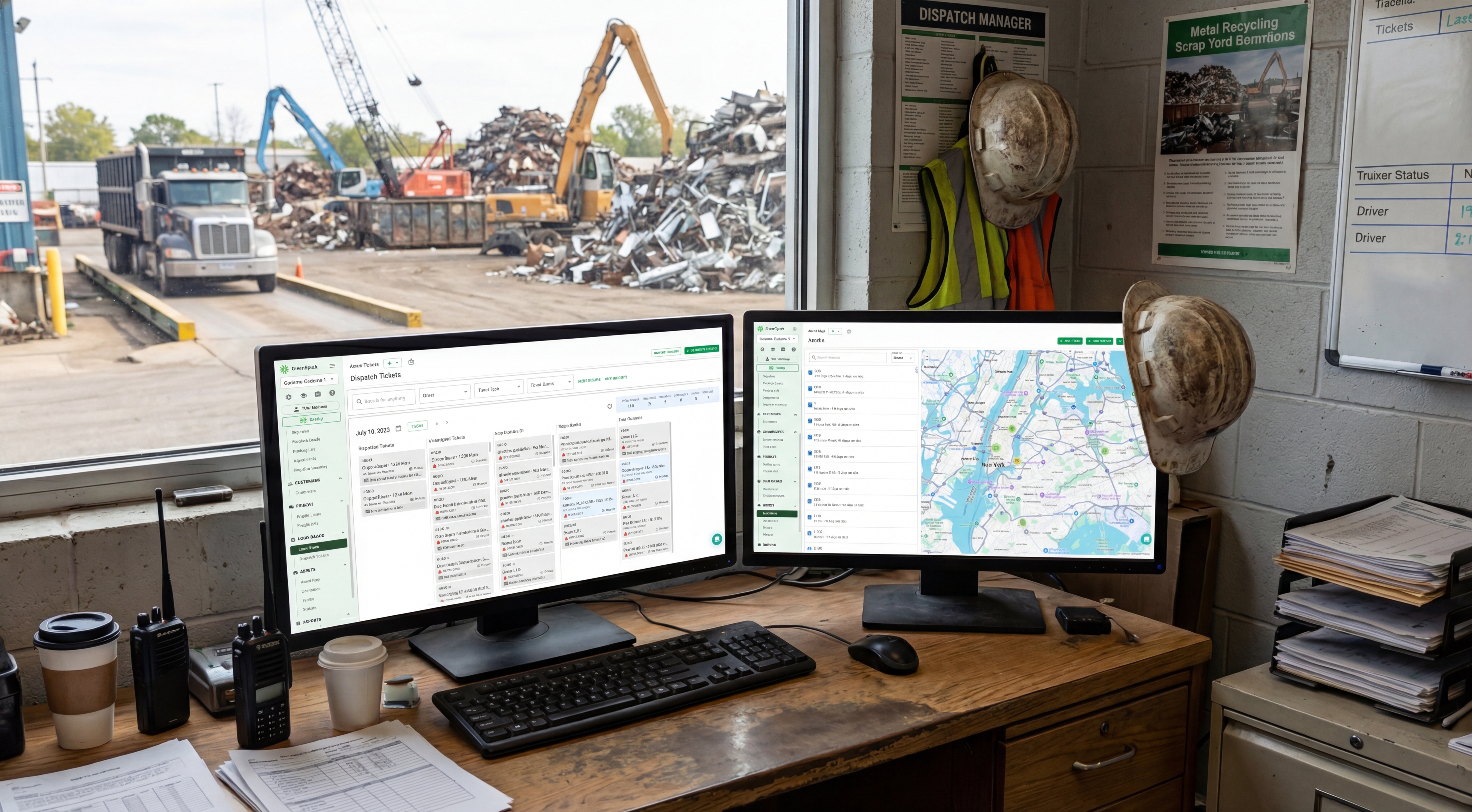
AI in Scrap Recycling Is Not a Buzzword. It Is a Structural Shift.
Artificial intelligence in scrap recycling is not about dashboards or chatbots. It is about transforming how work gets done.
Scrap operations generate enormous amounts of unstructured and semi-structured data, including inbound service emails, consumer contracts, price sheets, scale tickets, bills of lading, invoices, export documentation, market indices, camera feeds, and accounting entries.
Historically, humans acted as the integration layer between these systems. Staff members had to read emails, interpret contracts, create tickets, update pricing, reconcile invoices, and track containers across multiple disconnected systems.
Modern AI scrap software changes that model.
Instead of operators hunting for information across screens, AI agents traverse operational data in real time, surface clear next-best actions, and execute tasks within defined guardrails.
What GreenSpark Is Doing With AI Today
GreenSpark was built as a cloud-native scrap ERP platform, enabling AI to operate across the entire operational engine instead of being confined to isolated modules.
The result is role-based AI agents designed for specific operational workflows.
You can explore these capabilities through GreenSpark’s platform overview.
Dispatcher Agent
The Dispatcher Agent reads pickup requests directly from email or voice, drafts dispatch tickets automatically, assigns service types and locations, reserves containers, adds loads to route plans, and sends confirmations to drivers and customers. Dispatchers move from manual data entry to exception management. Learn more about Dispatcher Agent >
Operations Agent
The Operations Agent balances inventory, production, and capacity in real time. It flags bottlenecks before they impact throughput and identifies anomalies in material flow. Operations teams move from reactive firefighting to proactive optimization. Learn more about Operations Agent >
Commercial Agent
The Commercial Agent monitors commodity benchmarks, updates price lists within defined thresholds, drafts supplier outreach, approves routine tickets within guardrails, and generates contract drafts automatically. Buyers remain focused on negotiation and supplier relationships while routine execution runs autonomously. Learn more about Commercial Agent >
Finance Agent
The Finance Agent ingests settlements, bills of lading, invoices, and payments, drafts journal entries, reconciles freight bills, surfaces margin deviations, and flags exceptions before close. Month-end shifts from manual reconciliation toward exception management.
These agents operate on the same unified data model that powers purchasing, sales, inventory, logistics, and accounting across the platform. Learn more about Finance Agent >
Why Legacy Scrap ERP Systems Cannot Do This
AI cannot simply be bolted onto an old code base.
It requires real-time data availability, unified workflows, API-first infrastructure, continuous deployment cycles, and clear permissioning and audit layers.
Legacy scrap ERP systems – many built decades ago – were not designed with these requirements in mind. They typically rely on separate databases across modules, export-based integrations, rigid release cycles, on-premise architecture, and heavy customizations.
Because of this fragmentation, autonomous AI agents cannot operate effectively across the entire business.
Legacy Scrap ERP vs AI-Native Scrap Software
| Capability | Legacy Scrap ERP | AI-Native Scrap Software |
|---|---|---|
| Architecture | On-prem or fragmented modules | Unified cloud platform |
| Data Access | Delayed or batch exports | Real-time operational data |
| Automation | Basic workflow rules | Autonomous AI agents |
| System Updates | Slow release cycles | Continuous deployment |
| Operational Insight | Manual reporting | Real-time intelligence |
| Scalability | Limited | Built for growth and consolidation |
This architectural difference explains why AI in scrap recycling is not about who adds it first—it is about who built their platform for it from the beginning.
The Next Phase: Agentic Scrap Operations
The future of scrap yard software is agentic, meaning systems will not only automate tasks but actively observe, reason, and act across operational workflows.
Imagine an AI agent that monitors copper exposure across all yards and recommends hedge actions. A pricing agent could detect margin compression in real time and adjust quotes within defined guardrails. Logistics agents may predict demurrage exposure and automatically rebook shipments, while grading agents analyze camera images to flag potential fraud.
Voice agents may quote and schedule service requests without manual intervention, and finance agents may automatically close routine journal entries while surfacing only exceptions for review.
These capabilities are not independent tools. They operate as autonomous layers within a unified recycling software platform, which is why modern architecture matters.
Software Is Becoming a Competitive Advantage in Scrap
For decades, scrap operators competed primarily on relationships, market timing, operational efficiency, and geographic coverage. Software was rarely considered a differentiator because most systems performed similar administrative functions.
That dynamic is changing rapidly.
Operators adopting AI-native scrap software platforms gain faster decision cycles, reduced administrative labor, improved margin visibility, real-time risk detection, higher asset utilization, and shorter financial close cycles. They also create better experiences for suppliers, drivers, and internal teams because information moves through the business faster.
Velocity becomes advantage. Insight becomes leverage. Automation becomes throughput.
Software is no longer just operational infrastructure—it becomes a strategic asset.
A Platform Built for Modern Recycling Operations
Innovation in scrap has historically been cautious, but the industry is reaching a turning point.
As consolidation accelerates, labor tightens, and commodity volatility increases, the ability to operate faster and with greater clarity becomes strategic.
GreenSpark is building the operating system for that next era.
The platform is designed not only to record transactions but to execute alongside operators. It connects purchasing, scale operations, inventory, dispatch, export documentation, and financial reporting into a single unified workflow that follows material through the entire recycling lifecycle.
Learn more about GreenSpark’s platform or request a demo to see how AI-enabled scrap software works in practice.
Built with:
- AI-native architecture
- Unified operational workflows
- Continuous development velocity
- Enterprise-grade governance
- Deep recycling industry expertise
This is not incremental modernization. It is structural transformation.
The Competitive Divide Is Widening
Recycling companies that remain on legacy systems will continue to operate, but they will increasingly do so with slower decision cycles and heavier administrative workloads. Operators adopting AI-enabled platforms gain the ability to analyze operational data faster, automate routine workflows, and respond to market changes with greater speed and clarity.
Over time, that difference compounds. AI systems improve as they process more operational data, learn from corrections, and refine decision patterns across multiple yards and workflows. Each transaction, workflow, and operational adjustment adds intelligence to the system.
The result is a widening performance gap between organizations operating on traditional software infrastructure and those operating on modern AI-enabled platforms.
Final Thought
The future of scrap will not be defined by who has the most screens. It will be defined by who moves faster, identifies risk earlier, closes their books faster, and executes operations more efficiently.
For the first time in the industry’s history, scrap recycling software is becoming a source of competitive advantage.
And the operators who recognize that shift early will define the next decade.
FAQ: AI Scrap Software
What is AI scrap software?
AI scrap software is recycling management software that uses artificial intelligence to automate operational workflows such as dispatching, pricing, contract analysis, logistics coordination, and financial reconciliation.
How does AI help scrap recycling companies?
AI can analyze operational data in real time, automate repetitive administrative work, detect anomalies in material flow, and help operators make faster operational decisions.
What makes AI-native scrap ERP platforms different?
AI-native platforms are built on modern cloud architecture with unified data models and real-time data access, allowing AI agents to operate across dispatching, inventory, pricing, logistics, and finance.
Is AI replacing scrap yard employees?
No. AI is designed to automate routine administrative work so teams can focus on higher-value tasks such as supplier relationships, trading decisions, and operational optimization.